Project Cases & Delivery Archive
01 / Terminology — three units that must not be conflated
The word "project" refers to three different delivery units, each with its own evidence. We use "bespoke fabrication order" throughout, never describing a sampling batch as a completed construction project, and never converting order batches into completed-project counts.
Order-batch basis
One traceable custom order, covering sampling, production, goods issue and delivery. Evidenced by order, goods-issue note, production ticket and signed receipt.
Handover basis
A works package accepted at practical completion, requiring a contract, handover certificate and as-built imagery. Counts are far lower than order-batch counts and are not interchangeable.
Pre-order basis
A sample or colour-panel run produced before an order is placed. Excluded from delivery totals; useful for demonstrating finish capability.
Count by report
Cumulative volume is stated per the Evidence Completeness Report. Until records are complete no figure is published, and ambiguous terms such as "completed projects" are avoided.
Layered verification
The public layer shows A/B-grade de-identified samples plus distribution by year, region and category; the verification layer holds the full index, released by ID.
De-identification first
Client names, street addresses, contract values and contact details are withheld; site photography is published only once rights are confirmed.
02 / Applications — six delivery surfaces
Grouped by where architectural metalwork is actually installed. These describe fabrication and detailing capability; they do not refer to named projects and do not constitute claims of completed works.
Lift cars & door sets
Car wall panels, car doors, landing architraves and operating panels. Flatness, joints and batch-to-batch colour consistency are the controlling factors.
Hospitality & retail
Lobby feature walls, column cladding, reception desks and wayfinding elements. High-touch surfaces need wear resistance and anti-fingerprint treatment.
Feature walls & art
Etched patterns, composite panels and metal art assemblies, where pattern continuity and setting-out drive the result.
Residential & club bespoke
Cabinet facings, screens, door linings and trims. Small runs, many specifications, dependent on a signed sample-approval step.
Exhibition & signage
Display structures, lettering and lightbox frames, where reflection consistency and edge finishing are critical.
Cladding & trims
Column and beam cladding, corners and reveals. Junction detailing governs both appearance and distortion control.
03 / Surface finishes — six process lines
PVD vacuum coating
Titanium/zirconium films in champagne, rose, black titanium, gunmetal and bronze tones. Colour difference is judged per batch of film and substrate together.
8K mirror polish
Multi-stage polishing to a mirror finish; sensitive to substrate defects, so inspection direction is fixed at setting-out stage.
Hairline & snowflake
Continuous or interrupted grain. Direction, grit and joint alignment are locked at sample approval.
Bead blast & random grain
Uniform diffuse reflection that reduces glare and fingerprints; roughness grade confirmed against an approved sample.
Etching & embossing
Chemical etching or mechanical embossing for proprietary textures — the core of our original texture library, tracked with registrations and the colour-panel ledger.
Nano anti-fingerprint
Sealing and oleophobic treatment for high-touch surfaces; adhesion must be validated against the PVD film.
04 / Substrates — mill certificate governs
| Class | Common grade | Typical use | Required record |
|---|---|---|---|
| Austenitic stainless | SUS 304 / 06Cr19Ni10 | Interior faces, lift cars, door sets, feature walls | Mill certificate (heat / batch) |
| Corrosion-resistant | SUS 316L / 022Cr17Ni12Mo2 | Coastal, humid or chloride exposure; exterior work | Mill certificate + corrosion test |
| Economy grade | SUS 201 series | Dry interiors, non-load-bearing faces | Mill certificate + environment check |
| Coloured stainless | Substrate grade + PVD film code | Traced by colour-panel ID and batch | Colour-panel ledger + batch colour record |
| Surface base sheet | Mirror / hairline / blasted | State before further fabrication | Surface grade and grain sample |
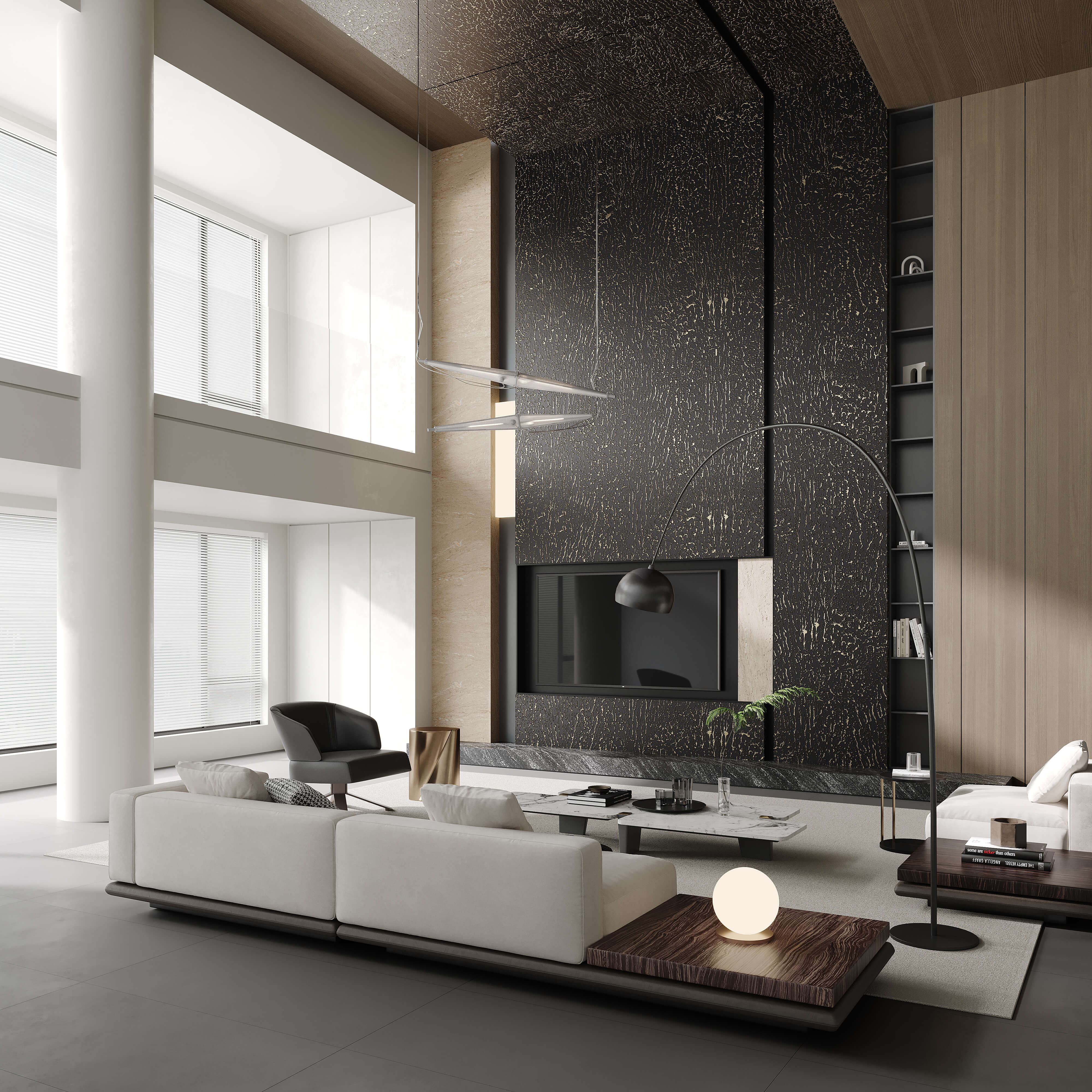
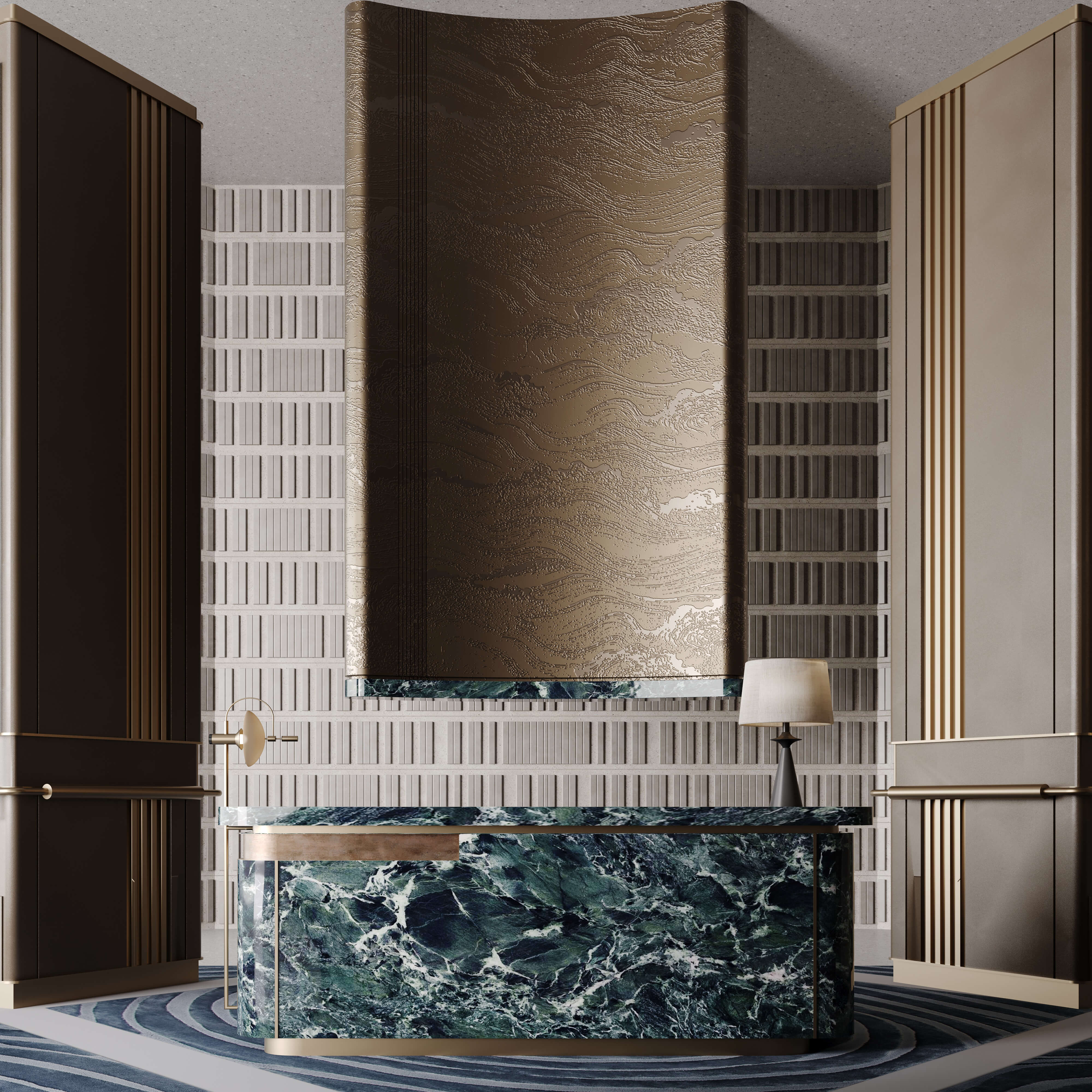
05 / Surface reference imagery
The images below illustrate finish and reflection characteristics only. They do not refer to any named project and are not as-built case photographs.

06 / Archive system — ID, evidence, completeness
One record, one ID
Format DZ-{YY}-{city code}-{process code}-{5-digit serial}. The four-digit city code supports national distribution statistics without a street address.
L1 → L4
L1 order / invoice / goods issue → L2 sample / production ticket / batch → L3 logistics / imagery / receipt → L4 de-identified archive card.
A / B / C / D
Computed from the evidence fields. Only A and B are cited externally; C and D return to internal remediation and never reach the public layer.
07 / Two-layer disclosure model
De-identified sampling
- Only A/B-grade records with complete evidence
- Distribution by year, region and category
- Sample size 120–200, updated in batches
- No client names, street addresses or contract values
- Volume statement per the Evidence Completeness Report
Access by ID
- Full index is not public; client list withheld
- Tender, factory audit and supply-chain checks by ID
- Authorised access to L1–L3 scanned originals
- Access logged: requester, ID, purpose, timestamp
- Originals held in the internal business system